

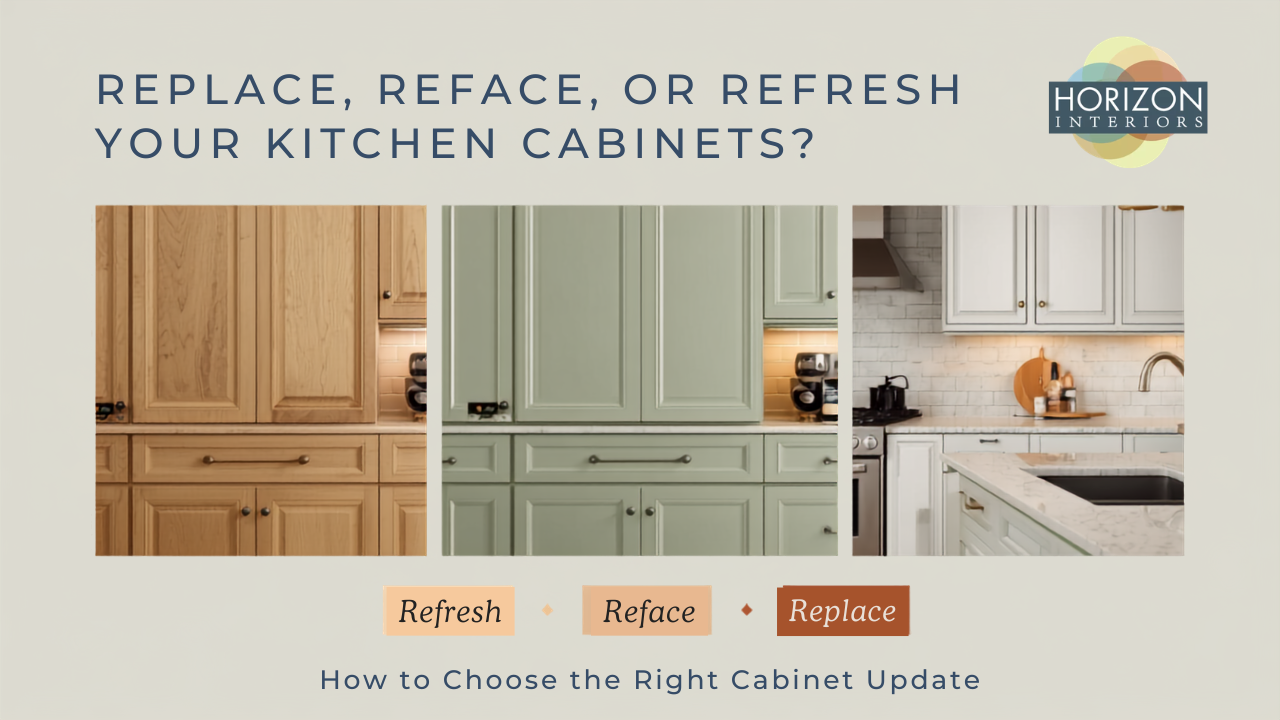
When a kitchen starts to feel tired, the cabinets usually get the blame. But tired cabinets are not all the same problem. Some just need a new finish and better hardware. Some need new doors. Some have sound boxes hiding behind worn surfaces. And some are failing where you cannot see it, under the sink or inside the frame. The right fix depends on which of those kitchens you actually have.
This guide walks through the four real options, refreshing, replacing only the doors and hardware, refacing, and full replacement, with a quick check-up to rate your own cabinets and clear explanations of what each option changes, what it costs you in time and disruption, and when it is worth it. It is written for kitchens like the ones we see around Woburn, Burlington, Reading, Melrose, Wilmington, Winchester, and Stoneham, from 1950s capes with original site-built cabinets to 1990s colonials with builder-grade boxes.
The Short Answer: Four Ways to Update Kitchen Cabinets
| Option | What you get | Best when | Relative disruption |
|---|---|---|---|
| Refresh | New finish (paint or refinish), new hardware, adjusted or replaced hinges and slides | Boxes and doors are solid; the look is tired | Lowest |
| New doors and hardware | New doors and drawer fronts in a new style, new hinges and pulls | Boxes and frames are sound; doors are dated or damaged | Low |
| Reface | New doors and fronts, veneer over frames and exposed sides, new hardware | Structure is sound, surfaces are worn, the layout works | Moderate |
| Replace | All-new cabinets, often with new countertops and a new layout | Boxes are failing, storage or layout does not work, or you want a full remodel | Highest |
The deciding factor is almost always the cabinet boxes. Doors, finishes, and hardware can be changed without touching the boxes; a failing box or a layout that fights you cannot be fixed by anything you put on top of it.
Start With an Honest Inspection
Before you price anything, look at your kitchen the way a cabinet installer would. Empty the sink base and look at its floor and back panel with a flashlight. Press on shelves to see whether they sag. Open every door and drawer and pay attention to how they move. Check the face frames, the solid strips around each opening, for looseness or splits. Then think about how the kitchen actually works: where you prep, where dishes pile up, and which cabinets you never use.
Walk through your kitchen and pick the answer that fits best for each question. The suggestion at the bottom updates as you go.
1Open the sink cabinet. How does its floor look?
2Press on the shelves and sides. How do they feel?
3Look at the frames around each opening.
4How do you feel about the doors?
5Open every drawer and door. How do they move?
6Does the layout work for how you cook?
Options from the smallest job to the biggest:
Answer the questions above to see which option fits your kitchen.
A starting point, not a diagnosis. Hidden water damage and structural issues are best confirmed in person.
The sink base deserves special attention in Massachusetts homes. Slow drips from supply lines and drains can soak the cabinet floor for years before anyone notices, and winter condensation on cold-water pipes adds to it. If the floor of the sink cabinet is swollen, stained dark, or soft when you press it, treat that as a structural finding, not a cosmetic one.
Warning signs that are easy to miss in older kitchens
- Hidden leaks. Dark rings, a musty smell, or a soft spot in the sink base usually mean a slow drip. Fix the plumbing first, whatever option you choose.
- Cabinets that are not anchored well. Upper cabinets should be screwed securely into framing. Gaps at the wall or a cabinet that shifts when you pull on it need attention before anything else.
- Soffits and odd bulkheads. Boxed-in areas above older cabinets can hide ducts, plumbing, or wiring, which matters if you are considering cabinets that run to the ceiling.
- Floors that dip. An uneven floor makes doors drift open or refuse to close, and it affects how new cabinets are leveled.
- Older paint. If your home was built before 1978, painted cabinets and trim may contain lead. Sanding or removing that paint calls for lead-safe work practices, and federal rules require renovators to follow them in older homes.
What Each Option Actually Changes
The four options sit on a spectrum from surface to structure. Seeing which parts each one touches makes the trade-offs much easier to compare:
Pick an option. The colors show which parts of the cabinet are new, which are refinished or covered, and which stay as they are.
NewRefinished or coveredStays as is
- 1Countertop
- 2Face frame
- 3Cabinet box
- 4Drawer front
- 5Doors
- What changes: Existing doors, drawer fronts, and face frames get a new finish (paint or refinish); hardware is usually replaced; hinges and slides are adjusted or swapped.
- What stays: Boxes, layout, and countertops.
- Disruption: A few days to about a week, mostly working around a usable kitchen.
- Best when: Cabinets are solid and you like the layout, but the finish and hardware feel tired.
- What changes: New doors and drawer fronts in the style you choose, plus new hinges and pulls; face frames are painted or touched up to match.
- What stays: Boxes, layout, and countertops.
- Disruption: Usually a short installation once the new doors are made.
- Best when: Boxes and frames are sound, and the doors are the dated or damaged part.
- What changes: New doors and drawer fronts, new veneer or laminate over face frames and exposed cabinet sides, new hardware, and sometimes new drawer boxes.
- What stays: Box structure, layout, and usually the countertops.
- Disruption: Several days of on-site work; the kitchen stays partly usable.
- Best when: Boxes are structurally sound but frames and doors are worn, and the layout works.
- What changes: Everything: new cabinet boxes, frames, doors, drawers, hardware, and usually new countertops, with the freedom to change the layout.
- What stays: Walls, windows, and often the flooring and appliances if they still fit the plan.
- Disruption: The longest option; plan for weeks without a fully working kitchen, including countertop templating and fabrication.
- Best when: Boxes are failing, the layout does not work, or you want better storage and construction.
Option 1: Refresh What You Have
A refresh keeps your cabinets and gives them a new surface and better mechanics. Done well, it can make a solid kitchen feel new for a fraction of the disruption of any other option. A thorough refresh usually includes:
- Deep cleaning and degreasing, which matters more than people expect; paint and finish will not bond over years of cooking residue.
- Repairs, such as filling dings, re-gluing loose joints, and replacing a damaged shelf.
- A new finish. Painted cabinets need careful prep, a bonding primer, and a durable cabinet-grade enamel, then time to cure before heavy use. Stained cabinets can sometimes be cleaned and recoated if you like the color.
- New hardware. Pulls and knobs change the look of a kitchen more than their size suggests. Our guide to choosing knobs, pulls, and hinges covers finishes, sizing, and placement.
- Better mechanics. Swapping worn hinges for soft-close hinges and adding drawer organizers can transform how the kitchen feels to use. See soft-close hardware and smarter drawer systems for ideas.
A refresh cannot fix a layout that does not work, boxes that are failing, or doors that are warped. It also keeps your existing door style, so if the style itself is what you dislike, move to option 2. If you are planning a refresh, try a few combinations to see how much a new finish and new hardware can change the same cabinets:
Pick a finish and hardware to see how much a refresh can change the same cabinets, and what each choice involves.
Finish
Hardware
Close-up
- Finish: If you like the wood color, a professional clean and a fresh clear coat can revive it. Stain can make wood darker, but not much lighter.
- Hardware: Keeping old hardware saves money, but dated knobs can make a fresh finish look unfinished. Hardware is the cheapest part of a refresh to change.
Colors are approximate on screen. Paint suits wood doors and MDF doors (smooth pressed-wood board). Vinyl-wrapped doors (thermofoil) and peeling laminate do not hold paint well, which makes them candidates for new doors instead.
Option 2: New Doors, Drawer Fronts, and Hardware
When the boxes and frames are sound but the doors are dated, damaged, or simply not your style, replacing just the parts you see and touch is often the smartest value in cabinetry. New doors and drawer fronts change the entire character of a kitchen: a raised-panel traditional kitchen can become a clean Shaker or slab design without moving a single cabinet. Our article on door styles that modernize a traditional kitchen shows how much a door change can do.
This is also a service we provide. When a full replacement is not needed, our team can update doors and hardware on existing cabinets. A few details make or break the result:
- Matching the frames. The face frames stay, so they need to be painted or refinished to match the new doors.
- Overlay and hinges. New doors must fit the existing openings with the right overlay, and older cabinets may need new concealed hinges or adapter plates.
- Drawer boxes. If drawer boxes are falling apart, new fronts will not help; ask about replacing the boxes and slides at the same time.
Option 3: Refacing
Refacing goes one step further. In addition to new doors and drawer fronts, the exposed face frames and cabinet sides are covered with a new veneer or laminate so the whole kitchen reads as new, and hardware is replaced. Some refacing projects also add new drawer boxes, a few new cabinets, or crown molding. The boxes, the layout, and usually the countertops stay.
Refacing works best when the boxes are structurally sound, the layout already works, and you like your countertops. It is less disruptive than replacement because the kitchen stays largely intact. Its limits are just as important: refacing cannot fix water-damaged or failing boxes, cannot change the layout or add storage in new places, and on some kitchens its cost can approach the cost of new stock or semi-stock cabinets, which gives you better boxes for similar money.
Whether refacing makes sense usually comes down to what your boxes are made of and what shape they are in. Use this guide to check:
Open the sink base or look at the back edge of a shelf, then compare what you see.
Magnified edge of a shelf or cabinet panel
- How to spot it: Look at an unfinished edge, such as the back edge of a shelf or inside the sink base: you will see thin layers of wood glued together, like a stack of pages.
- With water and wear: Holds screws firmly and resists sagging. It can swell if soaked, but it usually dries and recovers far better than particleboard.
- Worth keeping? Almost always. Plywood boxes in good shape are strong candidates for refreshing, new doors, or refacing.
Magnified edge of a shelf or cabinet panel
- How to spot it: A raw edge looks like compressed wood chips and flakes, often hidden under a thin strip that covers the edge or a printed, plastic-like surface (laminate). Panels feel heavy for their thickness.
- With water and wear: Swells and crumbles when water gets past the edge, especially at the sink base, and swollen particleboard does not shrink back. Screws strip out more easily over time.
- Worth keeping? Only if it is dry, flat, and solid. Swollen or crumbling particleboard boxes are a strong signal to replace.
Magnified edge of a shelf or cabinet panel
- How to spot it: MDF (medium-density fiberboard) has a smooth, even edge with no layers or chips, like very dense cardboard. It is common in painted doors and some cabinet panels.
- With water and wear: Paints beautifully and stays flat, but like particleboard it swells if water gets into an unsealed edge.
- Worth keeping? Painted MDF doors in good condition refresh well. MDF boxes with water damage should be replaced.
Magnified edge of a shelf or cabinet panel
- How to spot it: End grain shows growth rings, and the grain runs continuously around the edges. Usually found in face frames and door frames rather than full cabinet boxes.
- With water and wear: Strong and repairable, and it can be refinished repeatedly. It moves slightly with seasonal humidity.
- Worth keeping? Yes. Solid-wood face frames are what make refacing and refinishing possible.
Our article comparing all-plywood vs. particleboard cabinet construction explains why the box material matters so much over the long term. When you meet with us, we will help you judge the construction quality of what you have before you decide what to buy.
Option 4: Full Replacement
Replacement is the right call when the structure is failing, when the layout fights you every day, or when the kitchen needs more than new surfaces: better storage, deeper drawers, a pantry wall, an island, or a layout opened to the dining room. New cabinets also let you upgrade construction, from the boxes to the drawer boxes and hinges.
At Horizon Interiors, we offer US Cabinet Depot cabinets, built with all-plywood boxes, dovetail drawers, and soft-close hardware, in Shaker, raised-panel, and contemporary door styles with finishes from crisp whites to warm stains and modern paints. Our kitchen cabinet buying guide explains construction, styles, and finishes in detail.
Replacement is also your chance to rethink the room. Moving a sink, adding drawers instead of base doors, running cabinets to the ceiling, or opening the kitchen to adjoining rooms are all on the table. For ideas, see our articles on smart storage ideas for compact kitchens and open-concept cabinet layouts for older homes. Because we design and install complete kitchens, our full kitchen remodeling service plans cabinets, countertops, tile, flooring, lighting, and plumbing together under one roof.
Not sure your boxes are worth keeping? We will look at them with you during a free in-home estimate and give you an honest answer.
Book a cabinet assessmentCountertops, Backsplash, and Floors: What Happens to Them?
This is where many cabinet budgets get surprised:
- Countertops. Refreshing, new doors, and refacing usually keep your existing countertops. Replacement usually means new countertops too, because stone and quartz tops rarely survive removal intact and new cabinets may not match the old footprint. If your counters are near the end of their life anyway, it can make sense to replace both at once. Compare materials on our countertop selection page.
- Backsplash. Tile set against the counter is often damaged when countertops come out, so plan for a new backsplash with any replacement project.
- Flooring. In many older kitchens, the floor does not run under the cabinets. New cabinets with a different footprint can expose gaps or old flooring, so decide early whether the floor is being replaced. Floors and cabinets also have to work together visually; our article on pairing cabinet colors with hardwood floors shows how.
- Appliances. Keeping appliances is easy with a refresh or refacing. With replacement, confirm the new layout fits the appliances you keep, especially refrigerator width and depth.
What Drives the Cost of Each Option
Prices vary with the market and the kitchen, so instead of numbers, here are the factors that move the total up or down:
- How many doors and drawer fronts you have. Door count drives the cost of refreshing, new doors, and refacing, since every front is prepped, made, or finished individually.
- Door style and material. Painted finishes, inset doors, and solid-wood construction cost more than simple stained or laminate options.
- Box repairs. Replacing a water-damaged sink base or reinforcing shelves adds to any keep-the-boxes option.
- Layout changes. Moving plumbing, gas, or electrical, or adding an island, only happens with replacement and adds trades to the project.
- Countertops, backsplash, and flooring. These are the biggest hidden line items in a replacement budget.
- Construction grade. All-plywood boxes, dovetail drawers, and soft-close hardware cost more up front than particleboard and basic slides, but they last longer, which matters when you plan to stay.
As a rule of thumb, cost and disruption rise from refresh to new doors to refacing to replacement, but the ranges overlap. A large refacing job can approach the cost of new cabinets, while a modest replacement with simple doors can cost less than you might expect. Our budgeting guide for a combined cabinet and flooring remodel shows how to allocate a larger budget, and our kitchen financing options let you spread the cost over time.
Time and Disruption: Living Through Each Option
A refresh or door update can often happen while you keep using the kitchen, with some rooms taped off and a few days of limited access while finishes cure. Refacing takes several days of on-site work, but the kitchen typically stays partly usable. Replacement is the longest: old cabinets come out, new ones go in, countertops are templated after the cabinets are installed and then fabricated, and plumbing, electrical, and backsplash follow. Plan for a temporary kitchen, a microwave and coffee maker in another room, for the duration. Our article on planning your first cabinet remodel covers timelines and how to keep the household running.
Which Option Adds the Most Value?
If you plan to sell soon, buyers mostly read cabinets as a sign of the home's condition: solid boxes, working drawers, and a clean, current finish send the right message, and a well-executed refresh or door update can deliver that at a modest cost. If you plan to stay for years, the math shifts toward fixing what bothers you daily, storage and layout, which usually means replacement. Our article on how cabinet upgrades affect resale value goes deeper.
Questions to Answer Before You Decide
A few honest answers usually make the decision obvious:
- How long will you stay? Short horizons favor a refresh or new doors; long ones favor fixing layout and storage.
- Does the layout work? If you love where everything is, keeping the boxes is realistic. If not, only replacement fixes it.
- What are the boxes made of, and what shape are they in? Plywood in good condition is worth keeping; swollen particleboard is not.
- Do you like your countertops? Keeping good counters is one of the strongest arguments for refreshing, new doors, or refacing.
- Are the appliances staying? New appliance sizes can force cabinet changes.
- How much downtime can your household handle? A few days of limited use and a few weeks without a kitchen are very different experiences.
- What is your budget ceiling? Knowing it up front lets a designer tell you which option gives you the most for it.
If you are also considering new flooring, decide before the cabinets are finalized so the floor and cabinets can be sequenced and coordinated.
Planning Your Cabinet Update With Horizon Interiors
Horizon Interiors is a family-owned Woburn company with more than 50 years of combined experience, and more than 90 percent of our business comes from referrals. Part of our process is educating clients so you can make the call that fits your home and budget. Here is how a cabinet project usually starts:
- Free in-home estimate. We measure the kitchen, look at your cabinets with you, and talk through which option makes sense.
- Design and selection. Try door styles, colors, and counters in the MSI kitchen visualizer, visit our Woburn showroom, or use our shop-at-home service so samples come to you.
- One coordinated plan. Whether you are updating doors or replacing everything, cabinets, counters, tile, flooring, lighting, and plumbing are sequenced by one team.
Browse kitchen and cabinet projects in our gallery and read homeowner reviews to see how local projects turned out.
Kitchen Cabinet Update FAQs
Is refacing cheaper than replacing kitchen cabinets?
Usually, but not always. Refacing avoids new boxes, countertops, and layout work, so it typically costs less and disrupts less. On larger kitchens with many doors, or where premium veneers are used, refacing can approach the cost of new stock cabinets, which would also give you new boxes.
Can particleboard cabinets be refaced or painted?
Only if the particleboard is dry, flat, and solid. Swelling at the sink base or crumbling at screw holes means the boxes are failing, and money spent on new surfaces will not fix them.
Can I replace just my cabinet doors?
Yes. If the boxes and face frames are sound, new doors, drawer fronts, and hardware can change the look of the kitchen without new cabinets. The frames are painted or refinished to match, and hinges may need updating.
How long does each option take?
A refresh or door update typically takes days, refacing several days of on-site work, and a full replacement several weeks once countertop fabrication, plumbing, and backsplash are included. Your estimate should include a schedule.
Should I replace countertops when I replace cabinets?
In most cases, yes. Stone and quartz tops rarely come off intact, and new cabinets often change the footprint. If you keep your cabinets, your countertops can usually stay too.
Is painting kitchen cabinets worth it?
It can be, on solid cabinets with doors you like. The result depends almost entirely on prep, primer, and a durable enamel, plus time to cure. It will not fix worn drawers, poor storage, or failing boxes.
What is the difference between refacing and refinishing cabinets?
Refinishing (or painting) keeps your existing doors and frames and gives them a new finish. Refacing replaces the doors and drawer fronts and covers the frames and exposed sides with new veneer or laminate. Refacing changes the style; refinishing changes only the color and sheen.
Can I add a few new cabinets to match my existing ones?
Sometimes, but exact matches are hard. Door profiles, wood species, and finishes change over time, and older finishes have aged. Adding cabinets is often paired with refinishing or new doors on the whole kitchen so everything matches.
How do I know if my cabinet boxes are worth keeping?
Check the sink base floor for swelling or soft spots, press on shelves, look for loose or split face frames, and identify the box material. Plywood boxes in good shape are usually worth keeping; swollen particleboard is not. When in doubt, have someone inspect them in person.
Get an Honest Answer About Your Cabinets
Whether your kitchen needs a refresh, new doors, or all-new cabinets, Horizon Interiors will help you choose the option that fits your home and budget. We serve Woburn, Burlington, Reading, Melrose, Wilmington, Winchester, Stoneham, Andover, and nearby Middlesex County communities.
Request Your Free Kitchen Estimate →


