

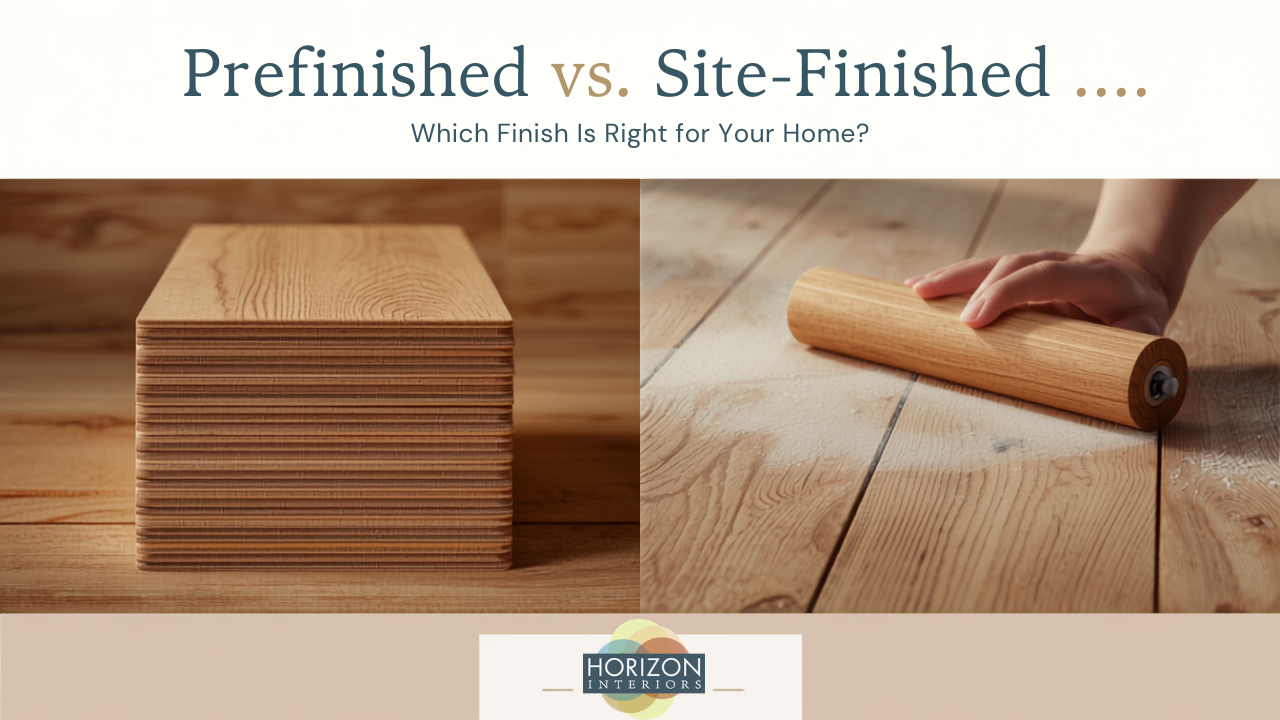
Every new hardwood floor ends with a finish, and there are two ways to get it there. Prefinished hardwood is sanded, stained, and coated in a factory, then installed ready to walk on. Site-finished hardwood arrives raw, is installed, and is then sanded, stained, and coated right in your home. Both are real wood, both can last for generations, and both are installed by our team at Horizon Interiors. The difference is where and how the finish is applied, and that one difference ripples into how the floor looks, how long the project takes, how your house feels during the work, and how the floor ages.
This guide explains both approaches in plain language, with simple interactive tools for comparing finish layers, edge profiles, and schedules, so you can decide which fits your home in Woburn, Burlington, Reading, Melrose, Wilmington, Winchester, Stoneham, or Andover. If you already know you want new hardwood, our hardwood installation team installs solid and engineered floors nailed, glued, or floated, with both site-finished and prefinished options.
The Short Answer
Choose prefinished when speed, a clean job site, and a tough factory finish matter most, when you will live in the home during the work, or when you want engineered or wide-plank flooring. Choose site-finished when the new floor has to blend into existing hardwood, when you want a custom stain color, or when you love a perfectly flat surface with no grooves between boards. Neither is better in every home. The right answer depends on the room, the house, and how you live.
| Factor | Prefinished | Site-finished |
|---|---|---|
| Where the finish is applied | Factory, before delivery | Your home, after installation |
| Finish type | Multiple UV-cured coats, often with aluminum oxide | Typically 2 to 4 coats of water-based or oil-based polyurethane |
| Surface and seams | Small bevels between boards; seams not sealed together | Flat, square edges; one film seals across seams |
| Color options | Manufacturer's colors only | Nearly unlimited; mixed and tested on your floor |
| Matching existing floors | Difficult to match exactly | Easiest, since old and new are finished together |
| Time on site | Installation only | Installation plus several days of sanding and finishing |
| Dust and odor | Minimal | Sanding dust and finish odor, especially with oil-based products |
| Future maintenance | Very durable, but recoating needs specific prep | Easy to screen and recoat with compatible finish |
A cut-away view of two neighboring boards. Pick one to compare; the finish layers are drawn thicker than real life so you can see them.
- 1Factory finish coats
- 2Aluminum oxide particles
- 3Small V-groove (micro-bevel)
- 4Stain and sealer
Each board is sanded, stained, and finished in the factory.
What it means for you: the finish goes on in several thin coats that are hardened under UV light in the factory, usually with aluminum oxide, a very hard mineral that improves scratch resistance. The floor is ready for traffic the day it is installed. Each board's edges are finished individually, which leaves small grooves between boards.
- 12 to 4 coats applied on site
- 2One film bridges the seam
- 3Sanded flat, then stained
Raw boards are installed, then sanded and coated together.
What it means for you: the finisher sands every board to one flat plane and applies the finish over the whole floor at once, so seams are sealed under one film and the color can be customized on the spot. The trade-off is days of sanding, drying, and curing in your home.
How Prefinished Hardwood Is Made
Prefinished boards move through a factory line where they are sanded, stained, and coated in a controlled environment. The finish is typically a urethane or acrylic-urethane cured instantly with ultraviolet light, applied in several thin coats, and often reinforced with aluminum oxide, a very hard mineral that improves abrasion resistance. Because every board is coated under identical conditions, the color and sheen are consistent from carton to carton, and the finish is fully cured before it ever reaches your home.
Factory finishing is also why prefinished floors have bevels. Even well-milled boards can sit a hair higher or lower than their neighbors once installed. On a site-finished floor, sanding flattens those differences; on a prefinished floor, a small chamfer on each edge disguises them. Browse micro-beveled hardwood in our catalog to see how subtle a modern micro-bevel can be.
Manufacturers usually back their factory finishes with written residential finish warranties, but the details vary a lot: what counts as wear-through, what installation and cleaning rules apply, and what is excluded. Our guide to what hardwood warranties actually cover is worth reading before you compare brands.
How Site-Finished Hardwood Works
Site finishing starts with unfinished boards. After the wood acclimates to your home and is installed, the finisher sands the whole floor in several passes, typically with a large drum or belt sander, an edger for the perimeter, and a buffer to blend the scratch pattern. The result is one flat plane, board to board and wall to wall.
Next comes color. Stain can be mixed, blended, and tested directly on your installed boards, which means you judge the color on your actual species, under your own lighting. That is the same way our refinishing team tests colors on existing floors before committing. Finally, the finisher applies a sealer and topcoats. Most homeowners choose between water-based polyurethane, which dries clear and fast with lower odor, and oil-based polyurethane, which adds a warm amber tone and needs much longer between coats. Our article on choosing between oil-based and water-based polyurethane walks through that decision.
Durability: Factory Finish vs. Site Finish
Prefinished floors usually win the first round. A multi-coat, UV-cured finish with aluminum oxide is extremely resistant to abrasion from grit and foot traffic, and many prefinished finishes outlast a typical site-applied finish before showing wear. That durability is one reason prefinished floors are so popular in busy family homes.
Site finishes win on repairability. A worn site finish can be screened and recoated, a light abrading of the surface followed by a fresh protective coat, often in about a day. Recoating many prefinished floors is possible too, but factory finishes are so hard and slick that new finish may not bond without the right abrasion method and a compatible bonding product, so it takes a finisher who knows the product. When either floor eventually needs a full sand-down, both can be refinished as long as there is enough wood above the tongue: solid boards typically several times, engineered boards according to the thickness of their wear layer.
Scratches vs. dents: finish hardness helps with scratches and scuffs, but dents depend on the wood species underneath. A factory finish on a soft species will still dent under a dropped pan.
Bevels, Seams, and Flatness
The biggest visual difference between the two approaches is at the edges. A site-finished floor is sanded flat with square edges, so it reads as one continuous surface, the classic look of older New England homes. Prefinished floors have an edge profile, from a barely visible micro-bevel to a pronounced bevel or pillowed edge. Deeper bevels emphasize each plank and suit rustic and wide-plank looks; micro-bevels keep the floor looking nearly continuous.
Pick a profile to see how the top edges of two neighboring boards meet, magnified so the shape is easy to see.
Side view, magnified: the floor surface is at the top.
Square edge: Boards meet in one flat plane with no visible groove. Typical of site-finished floors, where sanding removes any height differences. Looks sleek and formal; the finish film seals across the joint.
Side view, magnified: the floor surface is at the top.
Micro-bevel: A tiny angled edge on each board forms a shallow V between boards. It hides slight height differences between factory-finished boards while keeping the floor looking nearly continuous. The most common prefinished profile.
Side view, magnified: the floor surface is at the top.
Eased edge: A softly rounded edge, slightly more visible than a micro-bevel. Common on traditional prefinished floors, in both narrow and wide boards.
Side view, magnified: the floor surface is at the top.
Full bevel: A deeper V that outlines every board, giving a rustic, plank-by-plank look. It suits wide planks, but the grooves collect more grit, so plan on vacuuming rather than just sweeping.
Side view, magnified: the floor surface is at the top.
Pillowed: Rounded, softly domed edges for a hand-worn, casual look, often paired with hand-scraped or distressed textures. Like a full bevel, the rounded seams hold more grit.
Edge profile affects cleaning too. Grooves collect fine grit and pet hair, so beveled floors are easiest to keep clean with a vacuum that has a hard-floor setting rather than a broom alone. On the other hand, those same grooves hide the tiny height differences that are unavoidable between factory-finished boards.
Water, Spills, and Seams
On a site-finished floor, the finish film runs continuously across the seams between boards. Spills and wet-mop water sit on the surface instead of finding their way into joints, which is why many people prefer site finishing in kitchens and near entries. A prefinished floor's seams are not sealed together, so small amounts of water can wick into joints if spills are left to sit.
There is a Massachusetts twist, though. When a site-applied finish glues boards together along their edges, a group of boards can shrink as a unit in a dry winter and open one larger gap instead of many tiny ones, an effect finishers call panelization. It is mostly cosmetic and closes as humidity returns, but it is one more reason to keep indoor humidity steady. Our seasonal care checklist covers the habits that protect either kind of floor.
Color, Custom Stains, and Matching Existing Floors
With prefinished hardwood, what you see is what you get. The color on the sample board is the color you will live with, and it will be consistent across every carton. That predictability is a real advantage, but your choices are limited to the manufacturer's palette.
Site finishing opens the full spectrum: custom blends, natural finishes that show the true species, and colors matched to trim, furniture, or an existing floor. Matching is where site finishing truly shines. If you are extending hardwood into a new addition, replacing a damaged section, or connecting rooms after removing a wall, the most reliable way to make old and new look like one floor is to weave in new boards and sand and finish everything together. Our refinishing team does exactly this kind of restoration work, and our article on whether to refinish or replace hardwood floors helps you decide how much of the existing floor to keep.
Timeline, Dust, and Living at Home During the Work
Prefinished floors are usually walkable as soon as installation is finished. Nail-down floors can take furniture right away; glue-down installations need the adhesive to cure first. There is no sanding dust from finishing and no finish odor.
Site finishing adds time after installation: a day of sanding, a day for stain if you choose one, then finish coats with drying time between each. Water-based finishes can often take two coats in a day; oil-based finishes usually need a day per coat. You can usually stay in the home but off the floors being finished, and modern dust-containment sanding reduces the mess considerably, though it never makes it disappear. Oil-based finishes bring a strong solvent odor for several days, which is why many families plan to be away. Pick each option to compare a typical week:
Pick how the floor will be finished to see a typical day-by-day schedule once the boards are installed.
Walk on it in socks: Right after installation (glue-down floors: once the adhesive cures)
Furniture back: Right away on nail-down floors
Area rugs back: Right away, on pads approved for hardwood
Finish smell: None from finishing
Walk on it in socks: About 24 hours after the final coat
Furniture back: Usually 2 to 4 days after the final coat; lift, never drag
Area rugs back: Typically 1 to 2 weeks while the finish cures
Finish smell: Mild. Most families stay home with the windows open and simply keep off the new finish
Walk on it in socks: About 24 to 48 hours after the final coat
Furniture back: Usually 4 to 7 days after the final coat; lift, never drag
Area rugs back: Typically 3 to 4 weeks while the finish cures
Finish smell: Strong solvent smell for several days; many families plan to be away
Assumes three coats on site-finished floors. Adding a stain color adds about one day before the coats. Always follow the finish maker’s instructions.
Not sure which schedule works for your household? We will map out the sequence with you before any work begins.
Get a free in-home estimateGetting Your Home Ready for Sanding and Finishing
If you choose site finishing, a little preparation makes the week far easier. Most of the mess is fine dust and finish vapor, and both travel farther than people expect:
- Clear the rooms completely, including closet floors, and take down curtains and artwork near the work area.
- Plan the HVAC. Forced-air systems can pull dust and odor through the house, so returns in the work area are usually covered and filters changed afterward. Ask your finisher how they want the system run during drying.
- Seal off doorways to rooms you are still using, and protect electronics in adjacent spaces.
- Arrange pets and kids so no one wanders across a wet coat; paw prints in fresh finish are a classic, avoidable repair.
- Know your exit routes. If the finish runs through a hallway or entry, plan how you will reach bedrooms, bathrooms, and the kitchen while each coat dries.
Winter and summer finishing in Massachusetts
Finishes cure best at moderate indoor temperature and humidity, so the season matters. In winter, keep the heat on during and after finishing; cold rooms slow drying and curing, and opening windows for ventilation in January works against you. In humid summer weather, running air conditioning or a dehumidifier helps each coat dry on schedule. Your finisher will follow the product's temperature and humidity limits, and it is worth asking how they handle the time of year you are scheduling.
Can you get a little of both?
Occasionally homeowners ask about applying a site-finished topcoat over a newly installed prefinished floor to seal the bevels. It can be done with compatible bonding products, but it adds steps, fills the bevels only partially, and may affect the manufacturer's finish warranty, so read the warranty and talk it through before committing. In most homes, choosing the approach that fits the room is simpler and better.
Species, Width, and Construction: What Is Available Each Way
Most engineered hardwood is sold prefinished, because the factory can finish the thin wear layer precisely and because engineered floors are often floated or glued over concrete where on-site sanding is impractical. Wide planks follow the same pattern; our article on wide plank flooring explains why engineered construction dominates wider boards. If you are weighing construction types, read when engineered hardwood makes more sense.
Solid hardwood comes both ways. Traditional solid strip and plank in oak, maple, and hickory are commonly installed unfinished and finished on site, and many solid lines are also available prefinished. You can browse solid hardwood options in our catalog, and our hardwood basics page explains solid and engineered construction side by side.
What Drives the Cost of Each Approach
Prices change with the market, so instead of numbers, here are the factors that move your total in each direction:
- Material vs. labor: prefinished flooring usually costs more per square foot as material because the finishing is done at the factory. Site-finished flooring usually costs less as material but more in labor, because sanding, staining, and multiple finish coats are done by hand over several days.
- Finish system: on site, the number of coats, stain work, and premium finishes all add to labor and material.
- Project size and layout: site finishing has setup costs that spread better over larger areas; small patch-and-match jobs carry more labor per square foot either way.
- Living logistics: if site finishing means moving out for a few days, count hotel, pet boarding, or scheduling costs.
- Existing floors: blending new and old hardwood usually means finishing on site, which can include refinishing adjoining rooms so everything matches.
An itemized estimate is the only way to compare the two for your specific rooms, and our flexible financing lets you spread the cost of a larger project over time.
Which Approach Fits Your Room and Home?
- Kitchens: site finishing seals seams against spills and lets the floor flow seamlessly into adjoining rooms; prefinished is faster and very durable if you wipe up spills promptly. If flooring is part of a larger kitchen remodel, sequencing matters: floors are often finished before cabinets or protected carefully afterward.
- Additions, patches, and opened-up walls: site finishing, almost every time, so new boards and old match.
- Whole-home new floors in an occupied house: prefinished spares you days of dust and odor.
- Basements and slabs: engineered prefinished flooring is the usual choice, with moisture testing first.
- Older colonials with original strip floors: site finishing matches the traditional flat, square-edge look.
- Rustic, farmhouse, or wide-plank designs: prefinished lines offer textures such as wire-brushed and hand-scraped surfaces with beveled edges that would be hard to reproduce on site.
Pick the statements that are true for your project. Each one adds weight to one side of the scale; matching an existing floor counts the most.
Evenly balanced
These point toward prefinished
These point toward site-finished
Pick the statements that are true for you.
Installation Matters Either Way
A flawless finish cannot save a floor installed over a problem. Both approaches depend on a flat, sound subfloor, proper acclimation to your home's conditions, correct fastening, and expansion space at the walls. Those details matter even more in older homes, where uneven joists and seasonal humidity swings are common; we cover the most frequent problems in installation mistakes we see in older homes. Horizon Interiors is family-owned, with more than 50 years of combined experience and more than 90 percent of our business from referrals, and our installers handle prefinished and site-finished floors alike.
Caring for Prefinished and Site-Finished Floors
Daily care is nearly identical: keep grit off the floor, use felt pads under furniture, clean with a damp (never wet) microfiber mop and a cleaner made for polyurethane-finished wood, and never use wax, oil soaps, or steam mops. Two differences are worth knowing. Beveled prefinished floors need a vacuum to lift grit from the grooves, and prefinished manufacturers may specify particular cleaners to keep the finish warranty valid. Site-finished floors, meanwhile, benefit from a periodic screen and recoat before the finish wears through. Our hardwood care and maintenance guide covers the full routine.
Prefinished vs. Site-Finished Hardwood FAQs
Is prefinished hardwood better than site-finished?
Neither is better everywhere. Prefinished is faster, cleaner, and usually has a tougher factory finish. Site-finished offers custom color, seamless matching with existing floors, and a flat surface with sealed seams. The best choice depends on your room, your schedule, and the look you want.
Can prefinished hardwood be refinished later?
Yes, if there is enough wood above the tongue. Solid prefinished boards can be fully sanded and refinished like any solid floor, and the bevels will shrink or disappear as the surface is sanded flat. Engineered boards depend on the thickness of their wear layer. Recoating without sanding is also possible with the right prep and bonding products.
Can we stay in the house while hardwood is finished on site?
Usually, yes, but you will need to stay off the floors being finished. Water-based finishes dry faster with less odor, so most families stay in other rooms. With oil-based finishes, the solvent odor lasts several days and many families plan to be away.
Can new prefinished flooring match my existing hardwood?
Rarely exactly. Existing floors have aged, may have square edges, and were finished with a different product. To make new and old read as one floor, the standard approach is to install unfinished boards and sand and finish everything together.
Why do prefinished floors have grooves between boards?
The small bevels hide the slight height differences between individually finished boards that would otherwise catch light and feel uneven. Micro-bevels are barely visible; deeper bevels are a deliberate rustic look.
Is site-finished hardwood better for kitchens?
It has an edge because the finish seals across seams, so spills stay on the surface longer. Prefinished hardwood also works well in kitchens when spills are wiped up promptly and mats are used at the sink.
Does prefinished hardwood cost more than site-finished?
The material usually costs more because the finishing is done at the factory, but installation labor is lower because there is no sanding or on-site finishing. Site-finished flooring flips that balance. The total depends on your rooms, species, and finish, so compare itemized estimates for your project.
Can hardwood be site-finished in the winter?
Yes, as long as the house stays heated to the finish manufacturer's recommended temperature during application and curing. Cold rooms slow drying, so plan on keeping the heat on and following your finisher's ventilation guidance.
How long does site-finished hardwood take in Woburn-area homes?
After installation, plan on about three to five days for sanding, optional stain, and finish coats with drying time, then additional days before furniture and rugs return. Oil-based finishes and extra coats add time; water-based finishes shorten it.
Talk Through Prefinished vs. Site-Finished for Your Home
Our team installs both, so you get an honest recommendation for your rooms, your schedule, and the look you want. We serve Woburn, Burlington, Reading, Melrose, Wilmington, Winchester, Stoneham, Andover, and nearby Middlesex County communities, and you can see what homeowners say in our reviews from local homeowners.
Request Your Free Hardwood Estimate →


