

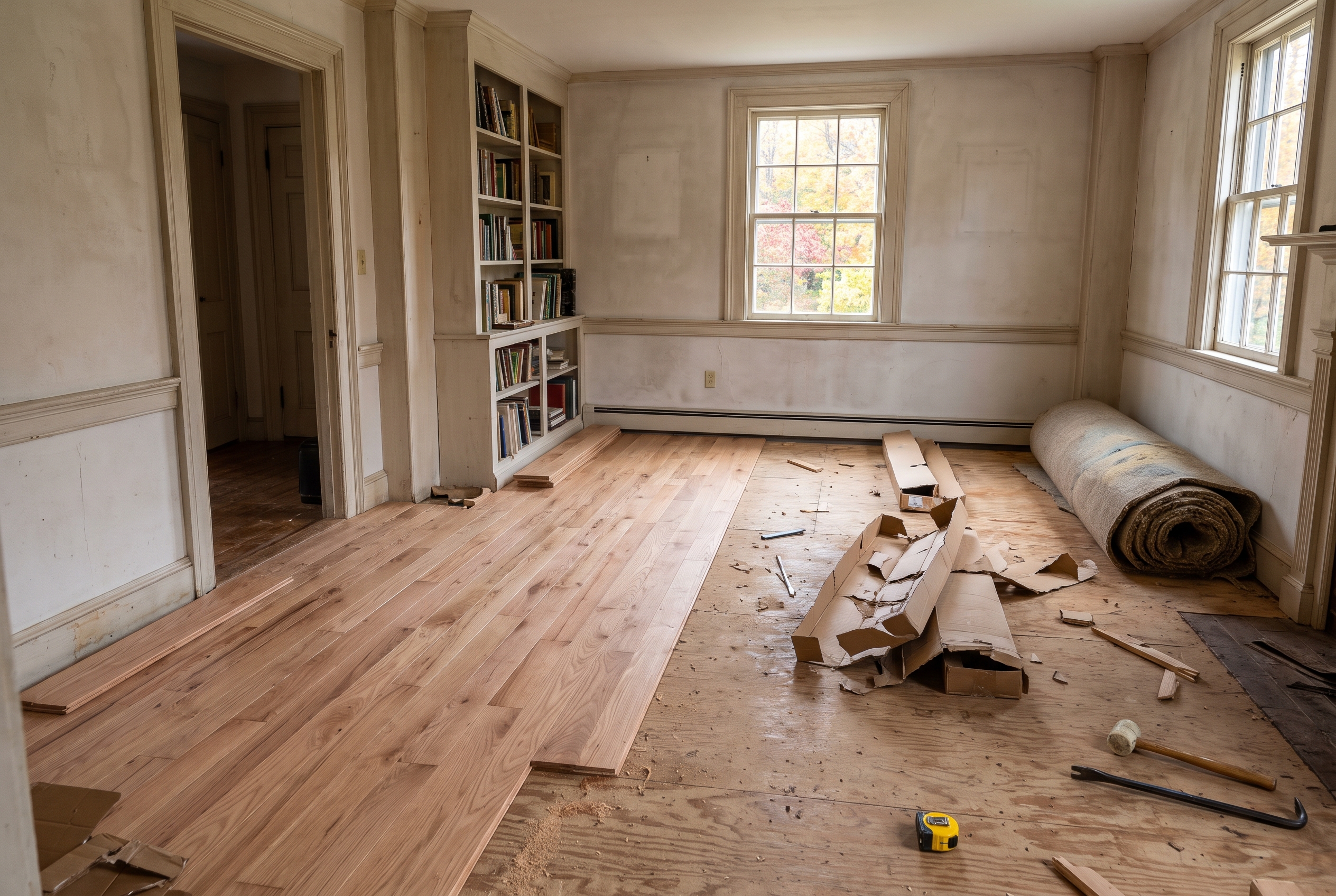
Maybe you pulled back a corner of the living room carpet hoping to find oak and found plywood instead. Or a quote is sitting on the kitchen counter and the total at the bottom looks like a typo. Either way, you want to know what a hardwood floor really costs to put down, and whether the number in front of you is a fair one.
For a starting number, Homewyse, a cost-estimating site that builds its prices line by line from material costs and labor rates, puts the national average for a basic hardwood installation at about $13 to $17 a square foot. That covers red oak that comes already finished from the factory, nailed down by a professional in a room whose floor underneath is already clean, flat and solid, along with the nails, the thin layer that goes under the boards, and the setup. It does not cover pulling up the old floor, fixing what is under it, new baseboard or the stairs, and those extras are where most real quotes move away from the online numbers.
| Space | Size | Low end | High end |
|---|---|---|---|
| A 12 x 12 bedroom | 144 sq ft | $1,900 | $2,400 |
| A good-size living room | 300 sq ft | $4,000 | $5,000 |
| Living room, dining room and hall | 600 sq ft | $7,900 | $10,000 |
| Most of a colonial's first floor | 1,000 sq ft | $13,200 | $16,700 |
Those totals are simply that per-foot range multiplied by each area, so read them as the new floor alone, before any tear-out, repairs or trim. A bigger job often comes in a little lower per foot, because the trip, the setup and the minimum charges are spread over more floor.
What an Installed Hardwood Floor Includes
A few words come up in every hardwood quote, so it helps to picture them first. Every finished floor sits on a structural layer called the subfloor. In newer houses it is sheets of plywood. In a lot of older houses around here it is rows of boards nailed across the joists, the beams that hold the floor up. The new hardwood is fastened to the subfloor, so its condition decides a good part of the price.
The wood comes in two kinds. Solid hardwood is one piece of wood, usually 3/4 inch thick, nailed to the subfloor. Engineered hardwood is a layer of real hardwood on top of a core made of thinner layers pressed together, which makes it less likely to swell and shrink with the humidity. Engineered boards can be nailed, glued or floated, which means the boards lock to one another and rest on a thin pad without being fastened down. Either kind can be prefinished, stained and sealed at the factory, or site-finished, installed raw and then sanded, stained and coated in your house.
When a price is quoted as "installed," it normally includes:
- The wood: plus extra for the pieces lost to cutting at the end of each row.
- The labor: laying the floor, nailing or gluing it, and cutting around doorways and vents.
- Underlayment and fasteners: the thin paper or foam layer between the subfloor and the wood, and the nails or glue.
- Setup and cleanup: protecting the rest of the house while the work goes on.
These often show up as lines of their own:
- Tear-out and disposal: taking up the carpet, tile or old wood and getting rid of it.
- Subfloor work: re-nailing, leveling, or replacing damaged sections.
- Finishing on site: sanding, stain and coats of finish, for unfinished boards.
- Trim: pulling and resetting the baseboard, or new baseboard, plus shoe molding, the thin strip along the bottom of the baseboard that hides the small gap a wood floor needs at the wall.
- Transitions: the strips at doorways where the wood meets tile, carpet or a floor of a different height.
- Stairs: priced by the step, not the square foot.
- Furniture and appliances: emptying the rooms and putting everything back.
Why Online Hardwood Prices Run From $6 to More Than $30 a Square Foot
Search for the cost of a hardwood floor and the ranges barely overlap. That isn't because somebody got the math wrong. Each figure prices a different job.
Fixr, another cost-guide publisher, which says it gathers its numbers from pricing databases, contractors and industry experts, gives a headline range of $14 to $32 a square foot installed, and its example for a 200-square-foot room includes a brand-new plywood subfloor. The same guide also gives $6 to $12 a square foot in its answers to common questions. Homewyse's $13 to $17 spells out exactly what it covers: a mid-range prefinished floor nailed over a subfloor that needs nothing, with no tear-out and no trim.
Two things separate the numbers you see online. The first is the job: some figures include taking out the old floor and building a new subfloor, and others assume a room that is ready to go. The second is how the figure was made: some are averages of what homeowners reported paying, and others are built up from material prices and labor rates. Actual costs also vary with the town and the conditions of each job.
So the number to hold next to your quote is the one that covers the same work. If your quote includes ripping out carpet, replacing a soft spot in the subfloor and new baseboard, compare it with the top of those ranges, not the bottom.
Solid vs Engineered Hardwood: How the Cost Compares
Homewyse puts a basic engineered floor, floated over a pad, at about $8 to $13 a square foot installed, against $13 to $17 for prefinished solid oak nailed down. The engineered floor in that comparison costs less both to buy and to put down. It is a basic product with a thin top layer, and floating boards go down faster than nailed ones. The gap narrows as quality goes up, and the better engineered floors, with a thick top layer and wide boards, cost about as much as solid.
That top layer is called the wear layer, and it matters over the long run. It is the only part of an engineered board that can be sanded, so a thin one may never be refinished, while a thick one can usually take a sanding or two. Solid hardwood can be sanded and refinished several times over its life, which is part of what you pay for.
Where the floor is going matters more than the price difference:
- Basements and concrete slabs: engineered. Solid hardwood isn't recommended below grade, meaning below ground level, while engineered can work in a dry basement that is heated and cooled with the rest of the house, and we test for moisture during the estimate before recommending a floor for one.
- Over radiant floor heat: engineered, because it moves less as the floor warms and cools.
- Kitchens: engineered, which our hardwood flooring page recommends for kitchens and other rooms where moisture comes and goes.
- Main and upper floors over plywood: either one works, and the choice comes down to looks, budget and how many sandings you want the floor to take.
- Matching oak already in the house: usually solid, so the new boards match the old in thickness and can be sanded together.
Choosing the cheaper floor for the wrong room is the expensive mistake. Solid boards over a damp slab can cup, which means the edges of each board rise above its middle as the underside takes on moisture, and no amount of sanding fixes a floor that is in the wrong place. If you are still deciding, our comparison of engineered vs. solid hardwood goes deeper into how each one handles a Massachusetts winter and summer.
How Species, Grade, and Plank Width Change the Price
The kind of tree matters, but less than most people expect. Homewyse prices each species on one bigger example, a 500-square-foot room with a few corners, in a standard grade with mid-priced labor. Red oak, the classic New England floor, and hickory, one of the hardest domestic woods, sit at the bottom. White oak and walnut cost a few dollars more a foot.
| Species | Total for a 500 sq ft room | About per sq ft |
|---|---|---|
| Red oak | $6,000 to $8,100 | $12 to $16 |
| Hickory | $6,000 to $8,100 | $12 to $16 |
| Maple | $6,300 to $8,500 | $13 to $17 |
| White oak | $7,300 to $9,700 | $15 to $19 |
| Walnut | $7,500 to $10,000 | $15 to $20 |
These species prices come from a larger room than the national average above, so they run a little lower per foot. Use them to see how the woods compare with one another.
Hardness is worth weighing if you have dogs or kids. Hickory and hard maple resist dents better than oak, and walnut, for all its rich color, is softer and shows dings sooner. Our hardwood species guide compares them side by side, and our post on white oak vs. red oak covers the two floors people around here ask about most.
Grade describes how the boards look, not how strong they are. A clear or select grade has few knots and an even color. A character or common grade keeps the knots, mineral streaks and color swings, and it costs less because more of each log qualifies. A busy household often does better with character boards anyway, since a new scratch disappears into the pattern.
Width moves the price too. Wider boards usually cost more per square foot, and most wide planks are engineered so they stay flat through humid summers and dry winters, which our post on wide plank hardwood flooring explains. Thickness matters mostly for engineered floors, where a thicker wear layer costs more and buys you future sandings.
When you're ready to compare real floors, our hardwood catalog filters by Wood Species and Construction, so you can put oak, hickory, maple and walnut side by side in solid or engineered.
Prefinished or Site-Finished: What Each Adds to the Bill
With prefinished boards you pay for the finish in the box. The factory has already stained and sealed them, so when the last board is down the job is done, and a nailed floor can usually be walked on right away. With site-finished boards the wood costs less, but the work goes on after installation: a day of sanding, stain if you want color, and several coats of finish with drying time between them, while those rooms stay off limits.
Fixr's guide finds that the two end up close once the finishing labor is counted, about the same total for a 300-square-foot room either way. So the choice is less about money than about what you want from the floor. People pay for site finishing to get a custom stain color, to have the finish run continuously across the seams so spills sit on top, or to match new boards to old oak in the next room by sanding and finishing them together. People choose prefinished to skip days of dust and drying and to get a hard factory finish. Our guide to prefinished vs. site-finished hardwood goes through the trade-offs room by room.
What Installers Charge For: Labor
In the national estimate we started with, the installer's time works out to about $5.70 to $6.90 a square foot, a little over 40 percent of the total. That covers more than nailing boards. It includes letting the wood adjust to the house, sorting the boards so the colors mix well, laying the underlayment, and protecting the rooms around the work.
Labor climbs when the job is fussy:
- Small rooms, closets and hallways: more cuts and more time for every square foot.
- Doorways: each one means trimming the bottom of the door casing, the trim around the door, so the new floor slides under it, and fitting a transition.
- Patterns: boards laid on a diagonal or in herringbone, the zigzag pattern, take far longer than straight rows.
- Obstacles: radiators, heating pipes, stone hearths and built-ins all have to be cut around.
- Glue-down floors: gluing engineered boards to concrete takes longer than floating them.
Small jobs also carry minimums. That same estimate builds in a two-hour minimum, which is why a single closet or a short hallway can cost more per square foot than a whole living room.
Tear-Out, Subfloor Repair, Trim, and the Other Line Items
These are the lines that separate a real quote from an online average. Homewyse prices most of them, which gives you something to hold up against a quote:
- Tearing out the old floor: about $183 to $691 for a 120-square-foot room, depending on what is coming up and how it is fastened, plus $145 to $165 to haul the debris away. Carpet and pad come up quickly. Tile set in mortar or a glued-down floor takes much longer.
- Subfloor repair: most subfloors need some attention: loose boards re-nailed, squeaks screwed down, high seams sanded and low spots filled. Where a section is soft or rotted it gets replaced, at about $4 to $6 a square foot for a new subfloor.
- Baseboard and shoe molding: existing baseboard is often pulled and put back, with new shoe molding at the bottom. New baseboard runs about $9 to $14 a linear foot installed.
- Transitions: every doorway where wood meets tile, carpet or vinyl needs a strip that covers the joint and evens out any difference in height.
- Furniture and appliances: rooms have to be emptied and put back together. In a kitchen that also means pulling the range, the refrigerator and the dishwasher.
- Waste: you buy more wood than you measure. The national estimate orders 129 square feet for a 120-square-foot room, about 7.5 percent extra.
One line you won't see priced on paper is the surprise under the old floor. Nobody can see the subfloor until the carpet or tile is up. A fair quote says up front how repairs found at that point will be priced, by the sheet of plywood or by the hour, so a soft spot by the back door becomes a decision instead of an argument.
Hardwood Stairs
Stairs are priced by the step, because each one is its own small project. A stair has a tread, the flat part you step on, a riser, the upright face between treads, and a nosing, the rounded front edge of the tread. Going from carpet to wood means pulling the carpet, the pad, and the tack strips (the wooden strips with small pins that hold carpet in place) and staples underneath, then either refinishing the treads that are already there or covering each step with new hardwood treads and risers.
Fixr puts new hardwood stairs at about $100 to $200 a step, or $1,200 to $2,600 for a typical straight run of 12 or 13 steps. Open sides, landings, turns and painted risers all add to it. If the treads under the carpet are already hardwood, refinishing them is usually the cheaper path.
What Older Woburn-Area Homes Add
About six in ten homes in Woburn were built before 1980, and nearly one in five before 1940. An older house adds work to a floor job that a newer one doesn't.
- Board subfloors: many older houses have subfloors made of boards rather than plywood. Loose boards get re-nailed, and depending on their condition and which way they run, the new floor may go across them or a layer of plywood may go down first.
- Floors that aren't flat: decades of settling leave dips and humps. Leveling them before the wood goes down is what keeps the new floor from squeaking and flexing.
- Radiators and heating pipes: pipes coming up through the floor have to be cut around neatly, and a radiator may need to be lifted so the floor can run under it.
- Doors and thresholds: layers of old flooring leave rooms at different heights, so doors may need trimming and doorways need transitions.
- Painted trim before 1978: if your house was built before 1978, the paint on its baseboard may contain lead. The U.S. Environmental Protection Agency's renovation rule requires anyone paid to disturb painted surfaces in those homes to be certified and to follow lead-safe work practices, which adds plastic sheeting, careful cleanup and time when trim comes off.
- Old vinyl tile and black adhesive: old vinyl flooring and the adhesive under it can contain asbestos. The EPA's advice is to leave material in good condition alone, never to sand it, and to have a trained, accredited professional take any samples rather than doing it yourself. In Massachusetts, removing asbestos means notifying the state Department of Environmental Protection and the Department of Labor Standards at least ten working days before the work starts, so test early.
None of this is a reason to give up on wood in an old house. It's a reason to have the floor looked at before you compare prices, because two quotes that look far apart may be pricing two different amounts of this work. Our post on hardwood installation mistakes in older homes shows what careful preparation looks like.
When Refinishing Beats a New Floor
Before you price a new floor, find out what is under the old one. Hardwood under wall-to-wall carpet is one of the most common discoveries in Woburn and Reading homes, and refinishing it usually costs a fraction of new flooring.
You can check without tearing anything up. Lift the carpet in the corner of a closet, where nobody will see the edge. Or lift a heat register, the metal vent cover set into the floor, and look at the cut edge of the boards around the opening. You'll see the species, the thickness, and how much wood is left above the tongue, the ridge along the side of each board that locks it to the next.
A floor is usually a good candidate when the boards are flat and tight, the damage is mostly in the finish, and there is plenty of wood above the tongue. Boards that are cupped, soft, stained black by water or worn thin by earlier sandings point toward replacing at least part of the floor.
We refinish and restore hardwood floors as well as install new ones, from sampling stain colors on your own floor to replacing damaged boards with matching wood. Our post on refinishing vs. replacing hardwood floors walks through the same choice from the homeowner's side.
How to Measure Your Rooms, and Why You Buy More Wood Than You Measure
A tape measure and a pad of paper are enough to get a working number.
- Sketch the space. Draw each room and split any L-shape into rectangles.
- Measure wall to wall. Take each rectangle's length and width at the widest points, and round up to the next half foot.
- Include the extras. Closets, hallways and the floor inside doorways all get wood.
- Multiply and add. Length times width for each rectangle, then add them together.
- Leave out only what the floor won't cover. Built-in cabinets come out of the total if the floor will stop at them. A kitchen island may or may not, depending on the plan.
- Add the waste. Plan to buy about 7.5 percent more wood than the area for straight rows, as the national estimate does, and more for a diagonal or herringbone layout.
A 13-by-15-foot living room is 195 square feet. Add a 4-by-12 hallway (48) and a 3-by-6 closet (18) and you have 261 square feet of floor. With 7.5 percent added for waste, that's about 281 square feet of wood. Keep any unopened leftover box, because a few matching boards make a future repair invisible.
Your own measurements are good for budgeting. For the order itself, our installation teams measure every room, because walls that aren't square and doorways that need special pieces change the count.
Reading a Hardwood Quote Line by Line
Two quotes are only comparable when they price the same job. Put them side by side and check that each one tells you:
- The area and the order: the square footage of the rooms and how much wood is being bought, so you can see the waste allowance.
- The exact floor: species, grade, board width, thickness, solid or engineered, and prefinished or site-finished.
- The prep: what subfloor work is included, and how repairs found after tear-out will be priced.
- Tear-out and disposal: whether they're included, and for which floors.
- The finish: for site-finished floors, the stain and the number of coats.
- Trim and transitions: whether the baseboard is reused or replaced, new shoe molding, and how many doorway transitions.
- Stairs: the number of steps and what is done to each.
- Furniture and appliances: who moves them out and back.
- What is left out: painting, permits, lead-safe work in an older house, and any asbestos testing.
When a quote comes in well above the online averages, the reason is usually on that list: the old floor has to come out, the subfloor needs work, the job is small enough that minimums take over, there are stairs, or the house is old. A quote that spells out those lines is easier to trust than a single number, which is why our free in-home estimates come with itemized pricing before any work begins.
Ways to Spend Less Without Regretting It
- Pick red oak or hickory: in the species prices above, both run about $3 to $4 a square foot less than white oak or walnut.
- Use engineered where it suits the room: at about $8 to $13 a square foot installed against $13 to $17 for solid, it is often both the cheaper floor and the right one in a basement, on a slab or in a kitchen.
- Choose a character grade: knots and color variation cost less, and they hide wear better in a busy house.
- Stay with a standard width: classic narrower boards cost less per foot than wide plank.
- Refinish what you can: if there is sound oak under the carpet, sanding and refinishing it usually costs far less than a new floor.
- Phase the house: do the main floor now and the bedrooms later, and buy enough wood for both at once so the color matches.
- Don't cut the prep: the subfloor work and letting the wood adjust to the house are what keep the floor flat, quiet and tight. Saving there tends to cost more later.
Hardwood Installation at Horizon Interiors
At Horizon Interiors, we sell and install both solid and engineered hardwood, nailed, glued or floated, in prefinished and site-finished options. You can browse floors in our hardwood catalog, see samples at our showroom at 134C New Boston St in Woburn, or have us bring samples to your home so you can judge the color in your own light.
We install every floor we sell with our own installation teams, who handle the measuring, the subfloor prep, the installation and the finishing. Furniture moving, tearing out the old floor and disposal are offered as part of our installation quote, so one team handles the whole job. We repair as well as replace, from damaged boards to squeaky or uneven subfloors, and we supply and install the trim and moldings that finish the edges. If the new floor is part of a kitchen remodel, our kitchen and bathroom remodeling team plans the floor and the cabinets together, so they are chosen and installed as one project.
As a family-owned company, we bring more than 50 years of combined experience in home redecorating to every floor, and we work in Woburn, Burlington, Reading, Melrose, Wilmington, Andover and the towns around them. If spreading out the cost would help, our financing options let you pay over time.
Questions People Ask About Hardwood Floor Prices
Can I save money by installing hardwood myself?
You can save the labor, which is a little over 40 percent of the national estimate. Whether it's worth it depends on the floor. A floating engineered floor is the most forgiving to install yourself. Nailing solid hardwood takes a flooring nailer and practice to keep the rows tight and straight, and site finishing is the hardest part to get right. Mistakes in the subfloor prep or the layout usually cost more to fix than the labor you saved.
How long does installing hardwood take?
The wood usually spends some time in the house first, adjusting to its normal temperature and humidity for as long as the floor's maker calls for. After that, a prefinished floor that is nailed down can be walked on as soon as it is installed. A site-finished floor needs a day of sanding, then stain and coats of finish with drying time between each, so plan on several more days before the furniture goes back.
Is hardwood more expensive than laminate or luxury vinyl?
Usually, yes. Homewyse puts a basic laminate installation at about $7 to $12 a square foot and luxury vinyl tile at about $9 to $14, against $13 to $17 for prefinished solid hardwood. Each floor has its place. Luxury vinyl is waterproof, laminate resists scratches well for its price, and hardwood can be sanded and refinished for decades. We sell and install all three, so we can show them to you side by side.
Can new hardwood go over my old floor?
Sometimes. Carpet and its pad always come up, because wood needs a firm base under it. A floating engineered floor can often go over a hard floor that is flat and sound, such as old vinyl or tile, when the floor maker's instructions allow it, and that saves the cost of tearing out. Solid hardwood has to be nailed into the subfloor, so what sits on top usually comes up first. If the old floor might contain asbestos, covering it is often the safer path than pulling it up, since the EPA's advice is to leave asbestos material in good condition alone and never to sand or scrape it.
Is winter a bad time to install hardwood here?
No, as long as the house is heated and kept in a normal range. The National Wood Flooring Association, the trade group for the wood flooring industry, says wood floors do best between 30 and 50 percent relative humidity and 60 to 80 degrees, and the maker of your floor may set its own range, which is the one to follow. Heating dries the air in a Woburn winter, so a humidifier helps any wood floor through January and February. What to avoid is installing in a house that has been sitting cold and unheated, or right after a big project has filled it with moisture.
Does a new hardwood floor add value to a house?
Buyers often see wood floors as a premium feature. How much of the cost comes back when you sell depends on the house and the market, so choose it for the years you'll live on it as much as for the sale.
From National Averages to Your Own Number
National averages are a starting point. Your number comes from your rooms, what is under the floor you have now, and how much of the house the job reaches. At a free in-home estimate, we measure your rooms, walk through the options with samples in your own light, and give you an itemized price before any work begins.


